Reuzeit Emporium wishes you a peaceful and happy Thanksgiving.
Sunday, November 22, 2015
Thanksgiving Greeetings
Beautiful Antique Thanksgiving Postcards make great addition to your hostess gift. Share these special thoughtful messages with all your loved ones this year.
Tuesday, October 13, 2015
Wave Crest: Beautiful Opalware Glass
Many
people are confused when they see a decorated Wave Crest object. I have heard
people say, "What is this?
Porcelain? Glass? A collector
will immediately identify a piece as Wave Crest but an inexperienced observer is
often confused.
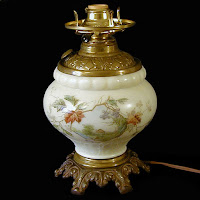
Wave Crest is glass. It is opal ware glass that people sometimes call milk glass but it is not the normal everyday milk glass. Most Wave Crest pieces are made in a mold and if you examine a piece you will be able to detect the mold lines. This thin transparent opal ware glass was manufactured by many different glass houses including Mount Washington Pairpoint. The undecorated glass called blanks was sold to decorating houses for embellishments. C F Monroe was one of the largest and most well know of the decorating factories employing many skilled well known artists.
As a first step in the decorating process, C F
Monroe, often put these undecorated pieces into an acid bath with the result being
a lusterless soft finish called satin
glass because the glass felt like satin to the touch. Only a few pieces of Wave Crest have been found with an untouched
shiny glossy finish. After the acid bath, many pieces were painted with a
pastel matte finish, light blue, pink, yellow background and then the true splendor of
Wave Crest began. The decorating!
Charles
Monroe employed some of the best skilled artists, including Carl V.
Helmschmied, Walter Nilson, J.J. Knoblauch, Joseph Hickish, Carl Puffee, Flora
Fiest, Gustave Reinman, Florence Knoblauch, Emil Melchior, and Alma Wenk,
Blanche Duval, Gussie Stremlan, Elizabeth Zeibart, and Elizabeth Casey. These artists decorated the glass with a gradient
degree of difficulty and design that C. F. Monroe sold by categories called assortments.
Assortment 1: consisted of decorations on a white ground that was then glazed, this was the least expensive.
The shaker on the left is an exception, it was purchased as blank by the C.F. Monroe and decorated with an applied transfer of orange, blue, and brown flowers. Today, only a few pieces of glossy items have been recorded and because these items are rare, they often demand a fairly high price. It is named Bulbous Necklace in Lechner's book, " The World of Salt Shakers, volume 2."
Assortment 2: consisted of decorations on a tinted ground glaze.
Assortment 2 1/2: consisted of decorations on a tinted ground with a fired bisque finish.
Assortment 3: consisted of decorations on a tinted ground glaze with more elaborate designs.
Assortment 4: consisted of decorations on a tinted ground with a bisque finish.
Assortment 5 consisted of decorations on a tinted ground with a bisque finish, the designs were traced in gold.
Assortment 6, consisted of decorations, traced in gold and were described as "very elegant and striking."
Special
order and totally hand painted pieces demanded the highest price and were the
most time consuming to paint. Transfers
were used to lessen the cost and the time required to paint the items. Sometimes both techniques were used on the same item, a transfer
was applied first and then the artist would add a few hand painted dots, flowers, or scrolls.
Wave Crest is glass. It is opal ware glass that people sometimes call milk glass but it is not the normal everyday milk glass. Most Wave Crest pieces are made in a mold and if you examine a piece you will be able to detect the mold lines. This thin transparent opal ware glass was manufactured by many different glass houses including Mount Washington Pairpoint. The undecorated glass called blanks was sold to decorating houses for embellishments. C F Monroe was one of the largest and most well know of the decorating factories employing many skilled well known artists.
|
|
|
|
|
|
Assortment 1: consisted of decorations on a white ground that was then glazed, this was the least expensive.
![]() |
| Bulbous Necklace Shaker |
The shaker on the left is an exception, it was purchased as blank by the C.F. Monroe and decorated with an applied transfer of orange, blue, and brown flowers. Today, only a few pieces of glossy items have been recorded and because these items are rare, they often demand a fairly high price. It is named Bulbous Necklace in Lechner's book, " The World of Salt Shakers, volume 2."
Assortment 2: consisted of decorations on a tinted ground glaze.
Assortment 3: consisted of decorations on a tinted ground glaze with more elaborate designs.
Assortment 4: consisted of decorations on a tinted ground with a bisque finish.
Assortment 5 consisted of decorations on a tinted ground with a bisque finish, the designs were traced in gold.
Assortment 6, consisted of decorations, traced in gold and were described as "very elegant and striking."
|
|
|
|
|
|
A trade
advertisement states, "Wave Crest is the most wonderful line ever
put on the market. The trimmings are all 24 carat gold plate, and the finish
and workmanship of the best, the decorations being hand painted and of numerous
designs to meet the tastes of all." There was a very large assortment of
Wave Crest items produced including vases, bowls, biscuit/cracker jars, pin
dishes, salt and pepper shakers and jewelry boxes. Some of the rarer items
include sugar sifters, napkin rings, paper weights, whisk broom holders, wig
holders and lamps. These pieces were made for everyday use and of course,
over time many were broken or just thrown away.
|
|
|
Wave
Crest pieces that were highly decorated and hand painted were most popular from
1890 to 1910 with C. F. Monroe at the forefront, being the largest producer of
decorated opal ware. However, demand for
this type of glass began to wane and C. F. Monroe went out of business in 1916. Today Wave Crest items demand a rather high
price due to the limited supply and the beautiful decorations.
In 1996, a group of collectors formed the, "Wave Crest Collectors
Club," to study the wares decorated by the C. F. Monroe Company. Check out their website: wavecrestcollectorsclub.org
Below is an example of the same shaker pattern
decorated with different finishes and flowers.
|
|
Tuesday, September 1, 2015
You Should Go......To Kokomo
![]() |
| Tour begins outside the glass factory |
If you love glass, you should go to Kokomo, Indiana and
visit the Kokomo Opalescent Glass Factory.
This factory has been in continuous operation since 1888
at its present location at 1310 South Market Street. They give daily tours but be sure to check
their schedule to start planning your tour. You will be pleasantly surprised.
On October 6, 1886 natural gas was discovered in a corn
field in Kokomo, Indiana and the Indiana Gas Company was formed to supply
natural gas to the surrounding area.
Charles Edward Henry was a glass chemist and in 1883, he formed Henry Art Glass in New Rochelle, New
York. The factory made glass buttons,
opalescent glass rods, and some novelties items. Charles heard about the natural gas discovery
and he traveled to Kokomo, met with local officials, and formed the Opalescent
Glass Works.
|
|
|
Within a month, he moved to Kokomo, brought a house and
started building the factory. On
November 13, 1888, the seven pot furnace started producing molten glass.
|
|
|
|
|
|
|
|
|
![]() |
| Tiffany stained glass window at Corning Glass Museum |
Today the company still operates using the tried and true
methods it used when the factory was first built. They have many of the old glass recipes and
the original texture presses that were used when Tiffany was purchasing glass
from them. Many antique shops and museums commission specific glass colors to restore lamps and stained glassed windows.
|
|
|
|
|
|
Monday, August 24, 2015
Friday, August 21, 2015
Wednesday, July 1, 2015
Sunday, June 21, 2015
Dead Horse Point State Park
Early May and the campgrounds are all full. Retires rule the state of Utah. It was still a great time to travel, even if was a little tough finding a campsite. Who could pass up these views?Thursday, June 4, 2015
Overnighting at Hittle Bottom Campground, Utah
As we were heading down Hwy 128 toward Moab in Utah, we were not sure if we would find a place to stay for the night. As we rounded the corner we came upon a quaint camping spot called Hittle Bottom. It is run by the The Bureau of Land Management and sits along the Colorado River. Look at the beautiful view we had! A random find of the magical kind.
Subscribe to:
Comments (Atom)